Thursday, February 17, 2011

Google's Art Project and the "aura"

HELLO!
It has been a while. I just realized that I have three followers, which is exciting, considering I thought no one visited this blog, never mind wanting to follow it. So hello to you and I hope you are having a lovely evening!

Have you visited the Google Art Project yet?
     
      A professor of one of my courses this semester brought it to the class' attention. I immediately ran home and tried it out. It is pretty amazing. You can visit all sorts of museums and view a wide range of works up close. I am a little disappointed that many of my favourite works are not up there and you can only zoom in on specific works. "Wandering" through the galleries is wonderful but if a work catches your eye you can't get close enough to it.

Here's a video of how Google went about creating this project:

How amazing would it be to get that close to a work? To wander through a gallery without other visitors?

I hope other galleries will join in. Its a fantastic tool for those with a bit of an interest in art to get close enough to see the details of a specific work. Maybe it will be the seeds of a love for art for those who do not wish to visit a museum.

     My professor posed a question that was quite interesting. Do you think this will replace the museum and the physical art piece?
     My reply would be no, not for me. It's great to be able to visit museums online and look at works close up, possibly closer than if you were actually in the museum (such is the case with the Mona Lisa, or so I am told). It brings to mind Walter Benjamin's theory of the "aura" and how photographic reproductions of works can never totally replace the experience of the work. Each art work contains its own "aura" that is lost in reproduction. I could not agree more. A couple of years ago I took a fantastic Bernini seminar course, in which the professor allowed us to experience learning art in a way that was only open to her graduate students. We attended a Bernini conference, which was a little piece of heaven on earth, as well as visiting the Ottawa National Gallery for the Bernini Portraits exhibition. It was amazing. As I have stated a great many of times, my love for Bernini is undying and fervent. Many of the portrait busts at the show were ones we had looked at, a great number of times, in class. You know they're great but you don't know how great until you stand before them. One such work was Bernini's Scipione Borghese. 

                                           Portrait Bust of Scipione Borghese, Gian Lorenzo Bernini, Marble, 1632


Studying it, you understand he was a large man, therefore, the work is a large piece. You are taught that the work has a life-likeness to it and it seems as though the marble is about to speak. Nothing I had read prepared me to see the actual work. It is massive, solid, and shiny. The man has such presence and you feel as though you are in conversation with him. As though his thoughts are rendered in his eyes and his tongue is about to speak what he his thinking. He was, and is, a large man. The shininess of the work tells you he's large, as though he is sweating because of the extra weight. There's a feeling, an emotion that every art piece has and it is something that cannot be captured by photography or Google. You have to physically stand before the work and feel it (although don't touch it!). It is in this way that the Art Project can never replace visiting the museum. Something I am sure the countries featured, tourist sites and museums are quite glad to hear!

Until next time. Thanks for reading.

Friday, July 9, 2010

Drama and Desire


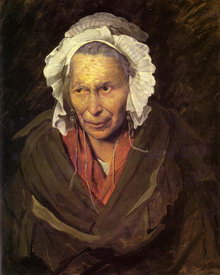
     I love Fridays! I am downtown and at the gallery surrounded by great pieces of art; my Heaven. This summer the AGO is showing an exhibit entitled Drama and Desire. I was a bit skeptical upon hearing about the exhibition. I feared the hype would not match the show. It was advertised as an exhibition displaying works by Jacques-Louis David, Eugene Delacroix, Jean Auguste Dominique Ingres, Edgar Degas, and so on. Aside from Baroque art, works from the Romantic period make my heart race. They are to touch you in ways other works are not supposed to. They appeal to every sense, dream and fear. Hearing of the show, a reel of Romantic pieces played in my mind; Liberty Leading the People, The Raft of Medusa, Gericault's Portraits of the insane, Oath of Horatii, Degas' tiny dancers, etc. Though these works have nothing to do with the thesis of the show–showcasing the drama and theatrics and the relationship between theatre and art– I prayed and hoped for the greatness of the period to reveal itself at the AGO.
I set myself up for disaster and a crashing wave of disappointment. Hearing the publicity for the show my hopes dwindled. The show's major work was, and is, David's Oath of Horatii. I have nothing against this work. It is magnificent, grand and Neo-Classical. I used to be in awe of this work but it seems to show up, in one way or another, in many art history courses. For lack of a better word, I am, quite plainly, sick of it.
      Today I saw Drama and Desire and I am far from disappointed. My prayers were answered and hopes fulfilled. I may not have seen Liberty Leading the People or Gericault's Portraits of the Insane but the lay out of this show was simply amazing.

     The first work the visitor sees is David's Oath of Horatii. I thought I was sick of this work, apparently, I was wrong! Though this is a contentious topic, it is hard to deny that this work is one the greatest works in art history. It is the culmination of art historical tradition into a nice Neo-Classical package. It perfectly and seamlessly displays advances in painting discovered decades, centuries, prior to this work such as depth through perspective, movement, triangular composition, and the masculine, muscular human form.  The work is pre-Revolutionary and was completed on the eve of revolution and movement. It is in every way the calm before the storm. Following this work the French Revolution of 1789 broke out and thus a wave of revolutions and movements followed. Revolutions in culture, society, politics, economy, industry, artistic movements, and religious movements, to name but a few.
     The Romantic Movement was a period of great change. We see the artist become more individualized and interiorized. Nature becomes a religious centre, replacing older orders and traditions. The Industrial Revolution not only played a role economically but also artistically, as seen in Turner's Rain, Steam, Speed.

Standing in front of David's Oath of Horatii one can feel the coming of great change. The work is too perfect, crisp, traditional. Then you notice the date and you can feel the wave rushing towards you.

      My favourite part of the exhibition was the Fuseli room and the Degas room. The Fuseli room contained a huge work of King Lear in which a small piece of the play was recited through audio speakers overhead. Spotlights were set up to highlight the characters parts, when heard, in the painting. Perfect. The viewer feels as though they are watching a play. No need for actors as the work moves and makes its viewer feel.
     The Degas room displayed his child ballerinas. I've seen these works in text books and online and in no way do these mediums do them justice. His ballerinas are graceful, young, and tired. You can hear the whispers from the audience, the music from the orchestra, and time slip away from the dancers as they perform before an eager audience. Beauty and contradiction rendered perfectly.
     I am far from disappointed. I do not regret playing the art history reel in my head, which plays nonstop and always to my satisfaction! I was incredibly pleased with the show, regardless of the exclusion of my favourites. I  suppose my favourites require a trip to their home instead of their trip to my home. I have learned that a textbook or computer cannot capture greatness; it cannot be duplicated and its "aura" is in fact lost through the medium of replication, as Walter Benjamin argued. I am glad I saw the Oath of Horatii in person, it is far greater than I could describe to you.


www.ago.net
All images from Google.


Tuesday, December 22, 2009

Bernini's Corpus


         I love art, everything about it. I love studying it, I love "googling" it, I  love all of it. I volunteer at a museum here in Toronto and I love it. I look forward to my Friday afternoons.
     Art takes me away from the real world. It's a trip without the drugs! I'm not saying that I love every piece of work ever created, that would be ridiculous. But certain works grab me and hold me. It is at this point that I become incredibly un-academic. It is funny what happens if you let yourself go. Certain works take me away. I always try and visit Bernini's Corpus when I volunteer on Fridays. You walk in the room and it calls your name. It subtly and quietly whispers me forward until I am directly below it. I look straight up at Christ's face and stare admiringly at His calm features. I look down at the platform which tells the viewer who donated the work and the usual artist name, date, and medium. I look back up and the gallery swirls around me and disappears. I watch the drapery, which is carefully placed around Christ's waist, flutter in the wind. I feel the cool wind whistle through the gallery entrance and the warm sand beneath my winter boots. I feel completely taken away, as if standing in the presence of Christ's last breath. And then it happens, students, families, museum goers enter the gallery and stand with me before Christ and I am taken back to present time.
         I look at them and wonder if they see what I see. If the museum is disappearing to them also. Sometimes, sadly, my questions are answered when they quickly walk away. Other times I watch them stare up also. Usually those who stare up are little kids, between 5 and 10 years old. They just stand underneath and stare. I remember one instance when a couple of young mothers visited the museum and I was assigned to stand right outside the gallery which houses the Corpus. They had little kids who were still waddling and crawling as they walked into the gallery. The mothers looked quickly at the work and then turned away to have a discussion of some sort. But their little children stopped in front of the work and plumped down on their diaper protected bottoms. They just sat there staring. Totally taken away with the work. Their mothers did not notice how entranced they were with the work. But I watched them and they could not take their eyes off of the piece, until of course their mothers swiftly scooped them up like trained athletes. I wondered what they saw. If they thought it was real man standing before them or if they were aware that he was not real. I wondered what they felt and what they were thinking. I mean they were babies, what could they be thinking? It's funny because I wondered if I stared at the piece in the same way, with the same awe.
       It must seem mad to those of you who are reading this. But this is why I love art. As a viewer, whether knowledgeable or not, art speaks to you, art can allow you to time travel and take you away. But only if you let it. A baby has no preconceptions about what is good or not. What is accepted to be good by institutions and the scholars attached to those institutions. They have no pretensions or previous knowledge. They just look, and when something grabs them, they stare in amazement.
     I am not crazy, well maybe partially. But this is art. It was, and is, created to make you feel. It was created for the viewers of the period to feel the moment and mood of their times. A piece of art does not need to be political in nature for you to feel a period. It is purely the style in which it was created; the way the brush hit the canvas, or the chisel stroked the marble. You can feel the Renaissance through the smooth oil paint on canvas, or the classical ideal of the body, or the beautiful drapery in the clothing. You can feel the modern period in the quick painterly brush strokes and the artist's fingers in the sculpture.
     I know this is incredibly anti-academic, discussing how the work makes me feel. But it is nothing but the truth. Before all things art makes me feel. Before I choose a work to write about, I always make sure I feel something for it before I research it. What is the use in researching a work if I have no feeling for it?
     I will try to be more academic in my following postings. I will try to read something and comment on it. But it will be about a work that makes me feel, a work that grabs me and shakes me around a bit.

Happy Holidays.

Image from the AGO website. www.artmatters.ca