
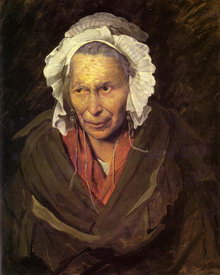
 I love Fridays! I am downtown and at the gallery surrounded by great pieces of art; my Heaven. This summer the AGO is showing an exhibit entitled Drama and Desire. I was a bit skeptical upon hearing about the exhibition. I feared the hype would not match the show. It was advertised as an exhibition displaying works by Jacques-Louis David, Eugene Delacroix, Jean Auguste Dominique Ingres, Edgar Degas, and so on. Aside from Baroque art, works from the Romantic period make my heart race. They are to touch you in ways other works are not supposed to. They appeal to every sense, dream and fear. Hearing of the show, a reel of Romantic pieces played in my mind; Liberty Leading the People, The Raft of Medusa, Gericault's Portraits of the insane, Oath of Horatii, Degas' tiny dancers, etc. Though these works have nothing to do with the thesis of the show–showcasing the drama and theatrics and the relationship between theatre and art– I prayed and hoped for the greatness of the period to reveal itself at the AGO.
I set myself up for disaster and a crashing wave of disappointment. Hearing the publicity for the show my hopes dwindled. The show's major work was, and is, David's Oath of Horatii. I have nothing against this work. It is magnificent, grand and Neo-Classical. I used to be in awe of this work but it seems to show up, in one way or another, in many art history courses. For lack of a better word, I am, quite plainly, sick of it.
Today I saw Drama and Desire and I am far from disappointed. My prayers were answered and hopes fulfilled. I may not have seen Liberty Leading the People or Gericault's Portraits of the Insane but the lay out of this show was simply amazing.
The first work the visitor sees is David's Oath of Horatii. I thought I was sick of this work, apparently, I was wrong! Though this is a contentious topic, it is hard to deny that this work is one the greatest works in art history. It is the culmination of art historical tradition into a nice Neo-Classical package. It perfectly and seamlessly displays advances in painting discovered decades, centuries, prior to this work such as depth through perspective, movement, triangular composition, and the masculine, muscular human form. The work is pre-Revolutionary and was completed on the eve of revolution and movement. It is in every way the calm before the storm. Following this work the French Revolution of 1789 broke out and thus a wave of revolutions and movements followed. Revolutions in culture, society, politics, economy, industry, artistic movements, and religious movements, to name but a few.
The Romantic Movement was a period of great change. We see the artist become more individualized and interiorized. Nature becomes a religious centre, replacing older orders and traditions. The Industrial Revolution not only played a role economically but also artistically, as seen in Turner's Rain, Steam, Speed.

Standing in front of David's Oath of Horatii one can feel the coming of great change. The work is too perfect, crisp, traditional. Then you notice the date and you can feel the wave rushing towards you.


I am far from disappointed. I do not regret playing the art history reel in my head, which plays nonstop and always to my satisfaction! I was incredibly pleased with the show, regardless of the exclusion of my favourites. I suppose my favourites require a trip to their home instead of their trip to my home. I have learned that a textbook or computer cannot capture greatness; it cannot be duplicated and its "aura" is in fact lost through the medium of replication, as Walter Benjamin argued. I am glad I saw the Oath of Horatii in person, it is far greater than I could describe to you.
www.ago.net
All images from Google.


